
Health made easier to understand.
Want the full picture? Visit the Diabetes landing page.
❓ What Is Diabetes?
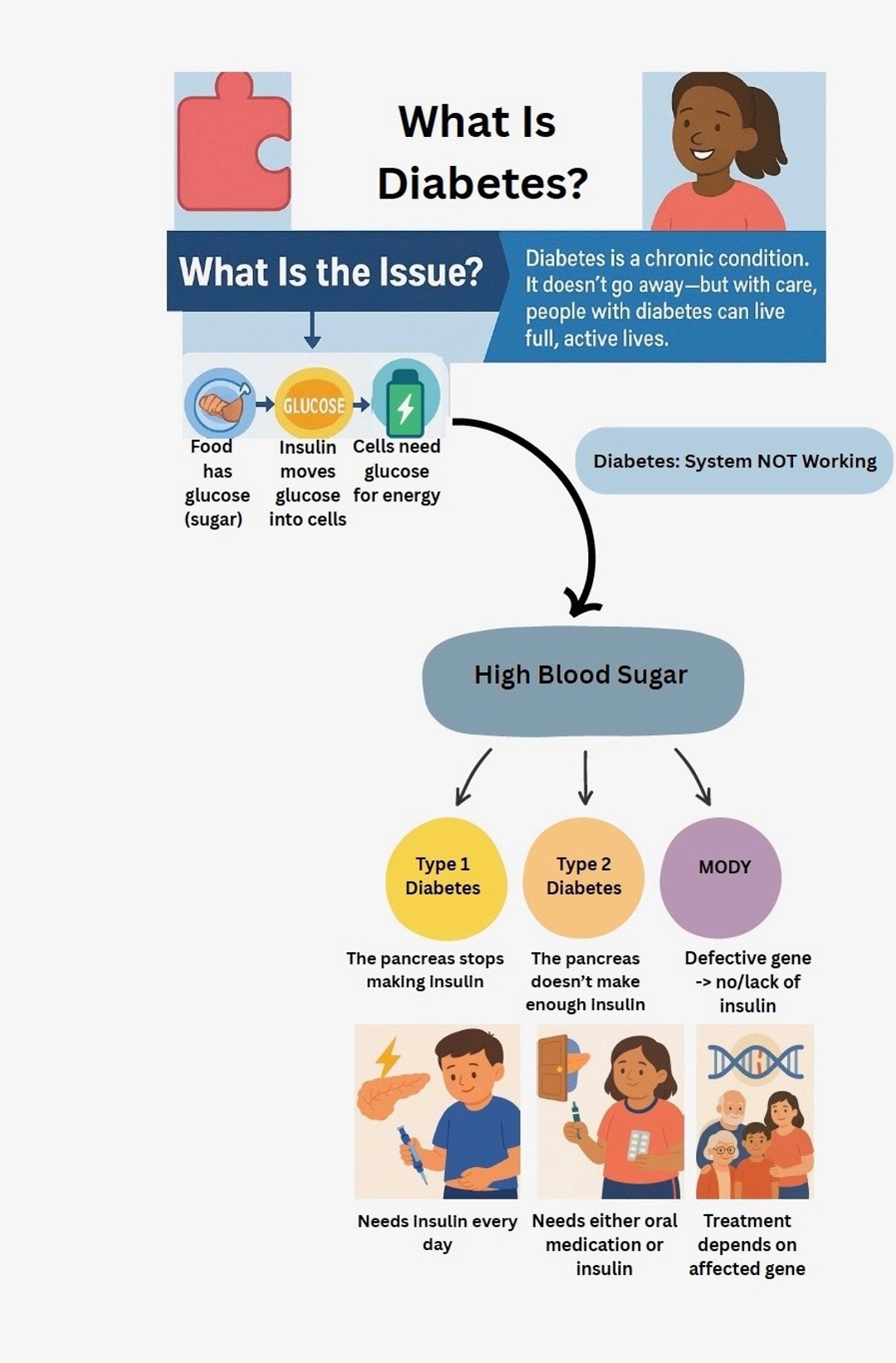
What Is Diabetes?
Open to view the infographic and download it.

📚 Diabetes Types, Quick Review Cards
Diabetes Types, Quick Review Cards
Tap a card to open. Everything is sized for phones: no side-scrolling or squished text.
Type 1 Diabetes (Autoimmune)
Immune system damages insulin-making cells
Type 1 Diabetes (Autoimmune)
Immune system damages insulin-making cells
- Often diagnosed in childhood or adolescence
- Antibodies present in blood tests
- Insulin needed from the start
- Symptoms may start quickly
More
HbA1c is checked every 2–3 months to see how well diabetes is managed.
Type 2 Diabetes (Insulin Resistance)
Body makes insulin but doesn’t use it well
Type 2 Diabetes (Insulin Resistance)
Body makes insulin but doesn’t use it well
- Becoming more common in teens; can occur at any age
- No antibodies against insulin-making cells
- Often develops gradually; symptoms may be mild
- Care plan may include healthy habits and medicines
More
Type 2 can affect people of any size. Movement, nutrition, sleep, and medicines help your body respond to insulin.
MODY (Monogenic Diabetes)
Single-gene forms; often run in families
MODY (Monogenic Diabetes)
Single-gene forms; often run in families
- Often diagnosed before age 25
- Seen across multiple generations
- No antibodies; not linked to insulin resistance
- Mutations in a single gene (confirm with genetic testing)
More
Common subtypes include MODY 2 and MODY 3; treatment differs by gene.
🩸 Diagnosing Diabetes – Steps to Diagnosis
Diagnosing Diabetes – Steps to Diagnosis
Follow each step. This is a guide for learning only and does not replace care from your healthcare team.
START → Suspect Diabetes?
Symptoms often include increased thirst, frequent urination, fatigue, or unexplained weight loss.
Step 1: Doctor’s Evaluation
Symptom notes, medical & family history, and physical exam.
Step 2: Urine Test
Check for glucose and ketones in urine.
Step 3: Blood Glucose Test
- Fasting glucose ≥ 126 mg/dL → possible diabetes
- Random glucose ≥ 200 mg/dL together with the classic symptoms → possible diabetes
Step 4: HbA1c
HbA1c ≥ 6.5% supports diagnosis (shows 2–3 month average). A normal HbA1c cannot rule out type 1 diabetes.
Step 5: Optional Oral Glucose Tolerance Test (OGTT)
Use when symptoms are absent/unusual; diabetes if 2-hr glucose ≥ 200 mg/dL.
Step 6: Determine Type
Antibody testing helps tell Type 1 from Type 2. If unclear, consider MODY.
- Autoimmune process
- Insulin needed from onset
- Insulin resistance pattern
- Care may include healthy habits and medicines
- Mild hyperglycemia; strong family history across generations
- No antibodies; not linked to insulin resistance
- Confirm with genetic testing
Step 7: Review & Diagnosis
Doctor reviews physical exam findings and test results together.
Checked against the ISPAD 2022 and 2024 guidelines. Managing a high or a low is not the same for everyone. Your own plan comes from your diabetes team, so follow theirs first and talk to them before you change anything you do.
🎉 How to Party Smart (Interactive Quiz)
Answer Key & Why
- Q1: B, A balanced meal gives steady energy and reduces later swings.
- Q2: B, Alternating alcohol with water keeps you hydrated and lowers risks.
- Q3: B, Dancing/walking is exercise; it burns glucose and can lower blood sugar.
- Q4: A, A final check plus carbs helps prevent nighttime lows.
- Q5: B, Hydration, breakfast, and glucose check help separate hangover vs. glucose issues.
🩺 Sick Day: What’s Important to Know When You’re Sick, Quick Quiz
Answer Key & Why
- Q1: Your body needs more energy to fight illness, and blood sugar can be harder to manage as a result.
- Q2: Stress hormones like cortisol push blood sugar up, and dehydration from fever, vomiting, or diarrhea adds to the challenge.
- Q3: Most teams suggest checking your blood sugar every 1–2 hours when sick and your ketones every 2–4 hours, more often if levels are unstable. And your background insulin keeps going even when you are not eating. Illness pushes blood sugar and ketones up, so stopping your background insulin is one of the fastest routes to DKA. Your team gives you your own checking frequency and tells you how to adjust doses.
- Q4: Sip small amounts every 10–15 minutes if you can’t keep much down.
- Q5: Avoid caffeinated drinks, they can worsen dehydration.
- Q6: Fluid choice depends on your blood sugar, ketones, and your team’s plan. Hydration alone doesn’t bring down a high, that’s what insulin is for.
- Q7: True. Small, regular meals or snacks with simple carbs (e.g., Jell-O, popsicles) help keep levels steady. Your team will tell you what’s right for you.
- Q8: Routinely when sick, ketones can rise even when blood sugar looks normal, and they can be an early sign of DKA.
- Q9: Family or friends can check on you and help if your blood sugar drops or you feel worse, important when you’re not feeling well alone.
- Q10: Ketones present means following your team’s sick-day plan and contacting them. Your plan has the exact steps for fluids, insulin, and rechecks.
- Q11: All listed items are red flags, contact your doctor or urgent care immediately.
- Q12: A written sick-day plan from your team, created before you get sick, is the most important thing to have ready. Ask your team if you don’t have one yet.
Important: This quiz is for learning only, not medical advice. Always follow your personal sick-day plan and your medical team’s instructions.
🥦 Nutrition and Carb Quiz
Nutrition and Carb Quiz
Short and interactive.
Look for the Select # badge. It tells you how many correct answers to choose.
Answer Key and Why
- Q1: A, D – A balanced diet helps keep blood sugar steadier and supports overall health and strength.
- Q2: A, B, E – Refined carbs like white rice and pastries and snack foods like chips can cause quicker blood sugar spikes and should be limited.
- Q3: A – A dietitian helps you understand which foods are healthy, what to limit, how to count carbs, and how to handle eating out or travel.
- Q4: A, B, D – Regular meals and portion control support steadier blood sugar and limiting sugary snacks helps prevent quick spikes.
- Q5: A – Wholegrains digest more slowly, which helps keep blood sugar steadier.
- Q6: A, B – Carb counting helps match insulin doses to food and reduces the risk of very high or very low blood sugar levels.
- Q7: A – When your blood sugar is above target before a meal, your plan may tell you to add a correction dose on top of your meal insulin. The correction is worked out with your correction factor, not by rounding up. Always follow your own team’s instructions.
- Q8: A, B – Food labels and the USDA FoodData Central database help you estimate carbs more accurately.
- Q9 (order): 5, 3, 6, 1, 4, 2.
Important: This quiz is for learning only, not medical advice. Always follow your personal diabetes plan and your medical team’s instructions.
Calculating Insulin Doses – Challenge
Type your answers as numbers (units). These are practice problems only. Always follow your care team’s plan.
Challenge 1
You plan to eat 50 g carbs. Your ratio is 1 unit per 10 g. How many units do you take?
Challenge 2
You plan to eat 55 g carbs. Your ratio is 1 unit per 10 g. Your blood sugar before the meal is 190 mg/dL, your target is 120 mg/dL, and your correction factor is 35. What is the total dose?
Challenge 3
You plan to eat 45 g carbs. Your ratio is 1 unit per 15 g. How many units do you take?
Challenge Answer Key and How to Calculate
- Challenge 1: 50 g ÷ 10 g per unit = 5 units.
- Challenge 2: Meal dose: 55 g ÷ 10 g per unit = 5.5 units. Correction: (190 − 120) ÷ 35 = 2 units. Total: 7.5 units. A pump or a half-unit pen can give 7.5. If your pen only dials whole units, your team tells you which way to round for you.
- Challenge 3: 45 g ÷ 15 g per unit = 3 units.
Important: These are practice calculations. Your insulin plan is individual. Always follow your medical team’s guidance.
📍 Locations for My Continuous Glucose Monitor (CGM)
⌄
Drag or tap the CGM icons below and place them on the exact body areas where CGMs can be applied.

Copy this into your block:
Pump Placement (Patch vs Tubed)
📦 Patch Pump
How to play: Drag the patches onto the matching teal dots on the figure.
Patch Pump Tips
- Place on soft tissue: upper abdomen, outer thigh, upper-outer buttocks, or back of upper arm.
- Avoid scars, lumps, or spots where clothing rubs.
- Press firmly; let adhesive set before activity or water.
⚠️ Always check your specific device’s Instructions for Use, and when in doubt, ask your diabetes care team before trying a new placement site. Approved pump placement and infusion set sites can vary by brand and by age.
🧪 Tubed Pump
How to play: Drag infusion sets (coral) and pump devices (blue) onto matching dots.

Tubed Pump Tips
- Infusion set on soft tissue (upper abdomen, outer thigh, back of upper arm, upper-outer buttocks).
- Pump device can be clipped to waistband, kept in a pocket, strapped to your leg, or placed between bra cup (girls).
- Route tubing so it won’t snag during sports or sleep.
⚠️ Always check your specific device’s Instructions for Use, and when in doubt, ask your diabetes care team before trying a new placement site. Approved pump placement and infusion set sites can vary by brand and by age.
📱 Scroll Smart: Social Media & Diabetes
Make a choice on each post to reveal a short tip. Tap “Next” to continue.
💛 If you’re struggling and need to talk to someone, tell a trusted adult or contact a youth helpline in your country. Find a helpline near you →
Feeling proud I kept my blood sugar in range today: 105 mg/dL 💪
Quick pic at the park with my device showing. 📍 Central Park
“Lemon water cures diabetes 🍋✨ #LifeHack”
“People with diabetes should just stop eating sugar 😂 #NoExcuse”
“Add me! I’m Mia from Jefferson Middle School, DM me 📱”
“Everyone else has perfect glucose control. I’ll never get it right. 😔”
“This new medication works better than insulin! Link in bio. #Ad”
“Night-time lows are tough. Anyone else?”
Your feed feels heavy today, lots of ads and downbeat posts.
“Check this diabetes website out, looks helpful. #Link”
✅ Taking Charge, Transition Checklist
Knowledge Basics
Nutrition
Social Situations
Sports and Exercise
Medical Appointments & Supplies
Daily Management
Overall Progress
Start checking items to see your progress…
Traveling with diabetes – checklist
Traveling with diabetes doesn’t have to be stressful. With some planning, you can stay safe and enjoy your trip.
Before You Go
Pack a Diabetes Travel Kit
While Traveling
Frequently Asked Questions
💬 Quick Answers
Can you eat sugar or sweets if you have diabetes?
You don't have to give up sugar completely. The goal is balance, carb awareness, and matching food to your insulin or medication plan. Sweets can fit into an overall healthy eating pattern when you plan for them.
How do you handle a sick day with diabetes?
When you're sick, blood sugar can change more than usual, so it helps to keep checking your levels, keep taking your insulin or medication as planned, stay hydrated, and follow the sick-day plan you set up with your care team.
Did eating too much sugar cause diabetes?
Sugar alone doesn't cause diabetes. Type 1 is an autoimmune condition, and type 2 involves genetics, insulin resistance, and many lifestyle and health factors working together, not just one food.
Can you play sports and be active with diabetes?
Being active is good for you and helps your body use insulin better. With some planning around blood sugar, snacks, and monitoring, people with diabetes play every sport, including at a competitive level.
Do all people with diabetes need insulin?
Not everyone. People with type 1 always need insulin, while many people with type 2 manage with lifestyle changes, other medications, or insulin only if needed. Your care team decides what fits you.
If your blood sugar feels normal, can you skip checking or medication?
Feeling fine doesn't always match what your blood sugar is actually doing. Sticking to your monitoring and medication plan keeps levels steady and helps prevent problems you can't feel yet.
Is insulin addictive or dangerous?
Insulin isn't addictive; it's a hormone your body needs. Using it for diabetes replaces what your body can't make or use well. Taking it as prescribed is safe and keeps your blood sugar in a healthy range.
Can you outgrow diabetes?
Type 1 diabetes is lifelong and doesn't go away. Type 2 can sometimes go into remission with changes over time, but it isn't cured and needs ongoing attention. Both are managed, not outgrown.
What do you need to know about traveling with diabetes?
You can travel with diabetes with a little planning. Pack more diabetes supplies than you think you'll need, keep insulin and medication in your carry-on, and bring a plan for meals, time-zone changes, and checking your blood sugar along the way.
Educational info only — not a diagnosis. Always check with your doctor or medical team.